
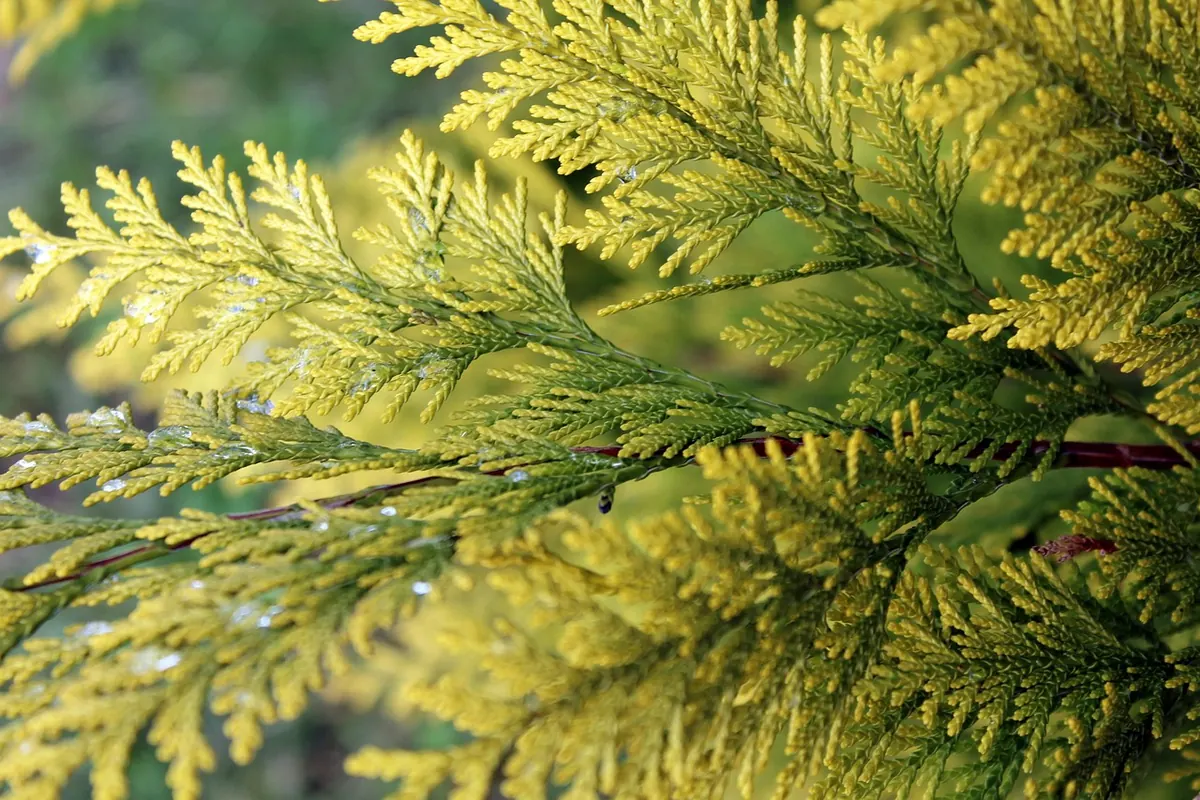
An Italian cypress should read like a dark green exclamation mark against the sky: dense, upright, and even in colour from the base to the tip. When the foliage starts turning yellow, the tree is not being dramatic. It is telling you, fairly precisely, that something in its circumstances has changed — and where the yellow appears tells you a good deal about what.
Some yellowing is normal. Cypresses shed older needles from the inside of the canopy each year, and after a dry summer or a cold winter you will find a scatter of straw-coloured needles deep in an otherwise healthy tree. The cases worth acting on are the ones where yellow spreads outward from the inside, appears on one side only, or arrives with bare twigs, resin or a thinning crown. Below are the causes that explain most of it, with what to do about each.
1. Watering: too much or too little
Water stress is the most common reason a cypress loses colour, and the two extremes look more alike than people expect. Both produce yellowing; the difference lies in texture, timing and position on the tree.
When the tree is too dry
Foliage turns a dull, matt green and then yellow, usually starting at the tips of the outer shoots. Needles feel crisp rather than soft, and the ground is dusty a hand's depth down. Newly planted cypresses are the usual victims, partly because their roots are still confined to the nursery rootball and partly because people water them daily in small amounts that never reach it.
A young tree needs a slow, deep soak — roughly 20 to 30 litres once a week in warm weather, poured over ten minutes into a shallow basin around the trunk. Then let the soil dry slightly before repeating. Deep and infrequent beats light and daily every time, because it draws roots downward instead of teaching them to sit at the surface.
When the tree is too wet
Overwatering shows as a softer yellow, often starting lower down and spreading up, with needles that droop rather than crisp. The soil stays damp for days and a green film may form on the surface. If you push a finger in and it comes out muddy, stop watering for a fortnight and turn your attention to drainage.
2. Poor drainage and the soil beneath the surface
Cypresses tolerate drought far better than standing water. Planted into heavy clay, or into a hole dug through a compacted layer, a tree sits in what amounts to a bucket after every rain. Roots suffocate, yellowing follows, and if it persists you get rot — darkened bark at the base, sour-smelling wood, steady decline instead of recovery between dry spells.
Test before you treat. Dig a hole about 30 cm deep near the drip line, fill it with water, and watch how long it takes to drain. If water is still standing after several hours, the issue is drainage, not your watering can. Break up the pan around the planting hole, work grit or coarse compost into the backfill, and keep the rootball slightly raised so water runs away from the trunk.
Soil chemistry creates a different pattern. On alkaline ground, iron becomes unavailable and you get interveinal yellowing — pale tissue between green veins — concentrated on the newest growth at the branch tips. A cheap pH test settles it. Above roughly 7.5, apply chelated iron to the packet's instructions and work compost into the surface; skip the lime, and be sparing with wood ash.
3. Cypress aphids and other sap-sucking pests
Cypress aphid is often behind a tree that yellows from the inside out in late spring. The colonies sit on inner shoots, out of sight, and the first sign is a greyish-yellow cast with a sticky sheen of honeydew, followed by sooty mould and ants running up the trunk. Part the branches and look into the shaded interior with a torch in the morning.
- Spider mites cause fine yellow speckling on older needles, plus faint webbing in hot, dry spells.
- Scale insects look like small brown or grey bumps on twigs and also leave honeydew.
- A strong jet of water into the inner canopy dislodges aphids without harming predators.
- Horticultural soap or neem oil handles light infestations; spray in the evening so foliage does not scorch.
- Leave ladybirds and lacewing larvae alone — they work harder than most sprays.
- Ease off high-nitrogen feeding; soft new growth is exactly what aphids want.
4. Cypress canker and fungal disease
This is the one to take seriously. Cypress canker, caused by Seiridium species, enters through bark wounds, pruning cuts and storm damage. The first sign is yellowing and browning on one branch or one side of the tree while the rest stays green — a pattern watering problems rarely produce. Cut into the bark at the edge of the dead patch and you will find a sunken dark lesion and often a trickle of resin.
Act quickly and cleanly. Prune at least 15–20 cm below the visible lesion on a dry day, and disinfect the blades with alcohol between every cut. Burn or bin the prunings; do not compost them or leave them on the ground. If the canker reaches the main trunk, no treatment will save the tree, and removing it is the responsible choice for the cypresses nearby.
Wet soils bring their own fungal troubles, particularly Phytophthora root rots, which cause general yellowing, poor growth and dieback that worsens each season. Better drainage is the only real defence.
5. Sun, frost, wind and reflected heat
Position matters. A cypress in a narrow strip against a south-facing wall, or beside pale paving, takes reflected heat on one flank all summer, and that side will yellow and bronze while the rest stays green. The same tree can scorch after a sudden heatwave following cloudy weeks, especially if the soil was dry beforehand.
Winter damage looks different. Cold wind and hard frost turn foliage a dull bronze or yellowish-brown, usually on the exposed side or the crown, and it often recovers in spring — wait for new growth before pruning anything. Water well in autumn, before the ground cools, so the tree goes into winter hydrated; a dry cypress is far more frost-sensitive than a watered one.
6. Planting and maintenance mistakes
Several small errors add up to chronic yellowing, and most are easy to correct.
- Planted too deep. The root flare belongs at or just above soil level. If the trunk vanishes into the ground like a post, dig the soil away until the flare shows.
- Mulch against the trunk. Keep a clear gap of about 10 cm; wet mulch held against bark invites rot.
- Grass and weeds at the base. They take every drop of water you give. A mulch ring out to the drip line makes a visible difference.
- Strimmer damage. One nick through the bark can be the entry point for canker. Hand-weed or fit a guard.
- Herbicide drift. Yellowing on one side with distorted, strappy new growth usually means chemical exposure, not culture.
- Pruning into old wood. Cypresses do not reshoot from bare branches, so a hard cut leaves a permanent gap.
A sensible order of work
Start with the pattern. Yellow on one side points to canker, reflected heat or root damage. Yellow from the inside out in late spring points to aphids. Yellow tips with crisp needles point to drought, while soft yellow low down suggests waterlogging.
Then check three things: the soil 10 cm down, the inner branches with a torch, and the bark for sunken lesions or resin. Water deeply if the ground is dry, stop entirely if
Photo: _Alicja_ / Pixabay