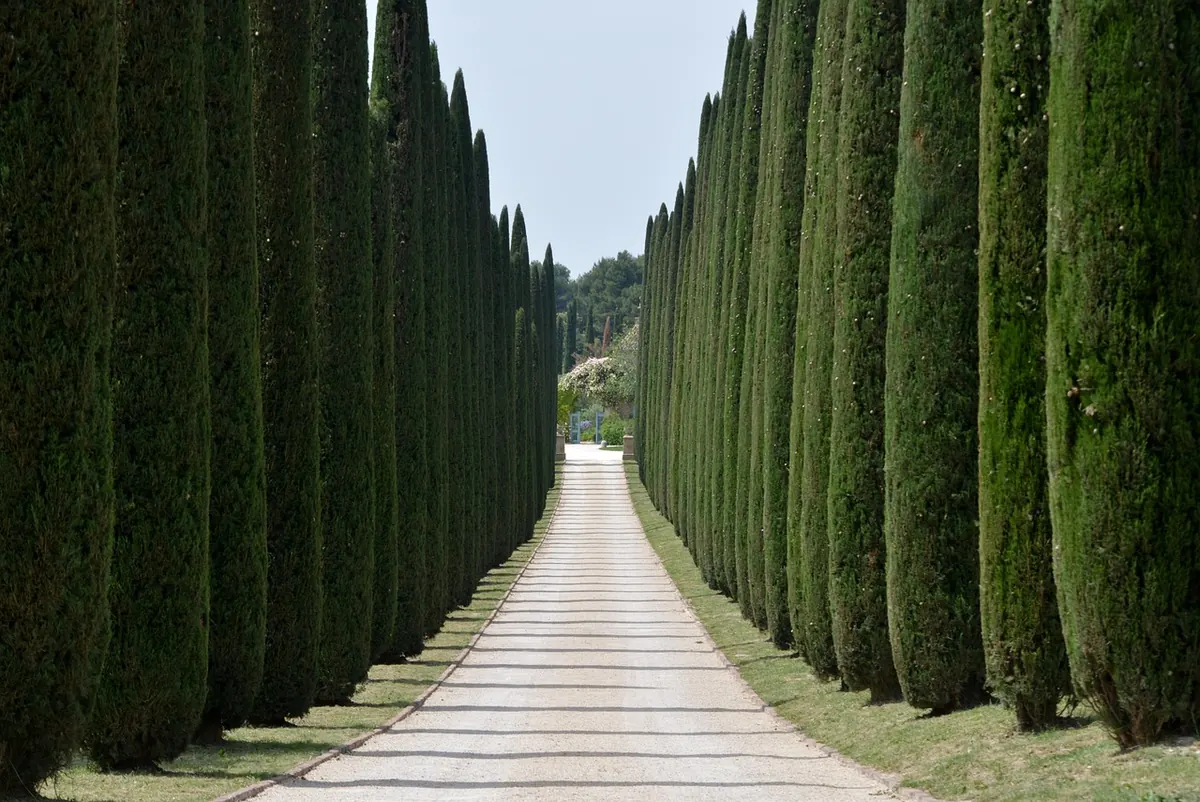

A cypress hedge looks simple from the road: a green wall, a clean line, a little Mediterranean order. The planting is less simple. Set the trees too far apart and you spend years waiting for gaps to close. Set them too close and you get a hedge that looks full for a season, then thins from the inside as light and air disappear. The right spacing is the distance that lets each cypress reach its natural width while still forming a continuous screen.
That distance changes with the cypress you choose and the job you want it to do. Here is how to work it out without guessing.
Begin with mature width, not pot size
A young cypress in a nursery pot tells you almost nothing about the space it will need. A vigorous Italian cypress may eventually spread close to a metre, while a broad grower such as Leyland cypress can spread several metres. If you plant by what fits in the car, you will almost certainly plant too tightly.
Look up the mature spread of the exact cultivar, not just the species. Labels often give height and spread, and that spread is the number that matters for hedge spacing. Then use a simple formula: centre-to-centre spacing = mature spread + the gap you want between mature canopies.
For a dense privacy screen, that gap can be small, roughly 0–20 cm. For better airflow and easier maintenance, leave 20–40 cm between mature canopies. A cypress with a mature spread of 80 cm, planted with a 20 cm air gap, goes in at about 1 m centres. If you want a tighter screen, 70 cm centres will give you slight overlap and faster closure.
A useful rule of thumb
For a conventional Italian cypress hedge, 60–90 cm between trunks is the usual range for a dense screen. Move toward 1–1.2 m if you want a looser screen, more airflow, or less annual trimming. For broad, fast-growing cypress, think in metres rather than centimetres: 1.5–2.5 m is more realistic. Very narrow columnar cultivars can go closer, but rarely below about 50 cm unless the label confirms a genuinely slim mature width.
Match spacing to the privacy you actually need
Privacy is not one thing. A screen that blocks a neighbour’s upstairs window is different from one that hides a seating area at eye level. If you need privacy from the ground up, the lower branches matter, and that usually means tighter spacing and careful early pruning. If you only need to break a view at first-floor height, you can afford wider spacing and a more open base.
Think about how quickly you want the hedge to work:
- Fast, dense screen in a small garden: Italian cypress at 70–90 cm centres, with light annual trimming to keep the face even.
- Relaxed screen with better airflow: Italian cypress at 1–1.2 m centres. Gaps close higher up, and the hedge feels less like a solid wall.
- Broad, fast-growing cypress: 1.5–2.5 m centres. Planting closer may look generous for a year or two, but the trees soon compete for light and water and often lose their lower branches.
- Low partition or courtyard edge: choose a genuinely compact cultivar and follow its label rather than forcing a large cypress into a narrow strip.
A single row is usually enough for privacy. A double staggered row makes a thicker screen, but it needs roughly twice the width. Space the rows about 1–1.5 m apart for Italian cypress and stagger the plants so you are not looking down two straight lines of trunks.
Leave room for air, light, and drying
Cypress trees handle Mediterranean summer heat well, but they do not enjoy a permanently damp, airless centre. Crowded hedges trap humidity after rain and in winter, and that is when fungal problems and dieback become more likely. Good spacing is not just about appearance; it is about giving each tree room to dry its foliage and keep its inner branches alive.
As a practical minimum, aim for 20–30 cm of air between mature canopies in a privacy hedge. Keep the hedge away from solid walls and fences, too. A clearance of about 1 m from a wall makes planting, watering, pruning, and air movement much easier. If you are planting near a boundary, check local rules and talk to your neighbour before the trees go in.
Mulch after planting, but keep it a few centimetres away from the trunk. Water deeply and less often rather than giving frequent light sprinkles. A cypress hedge that is watered well in its first two summers establishes faster and fills its allotted space more evenly.
Spacing by cypress type
Italian cypress
Cupressus sempervirens is the classic Mediterranean column. For a dense hedge, plant at 60–90 cm centres. For a more natural screen or a windy site, use 1–1.2 m. Narrow cultivars such as ‘Stricta’ types can be planted a little closer, but check the mature spread rather than assuming every Italian cypress is pencil-thin.
Leyland and other broad cypress
Leyland cypress is fast and wide. It makes a quick screen, but it needs space: 1.5–2.5 m between plants is sensible for a hedge, and more if you want individual trees. Arizona cypress and similar drought-tolerant broad growers also need metre-scale spacing. These are not trees to squeeze into a 60 cm strip.
Dwarf and compact cultivars
Small cypress used for low hedges or courtyard edges may need only 40–60 cm between plants. Read the label carefully, because “dwarf” can still mean a metre of spread. For a low partition, closer spacing is acceptable if you are prepared to trim lightly and regularly.
Set out the row before you dig
Spacing errors usually happen at planting time, not on paper. Take ten minutes to mark the line properly.
- Measure the proposed hedge line and note the mature spread of your chosen cypress.
- Decide whether you want a tight screen, a relaxed screen, or a windbreak, then choose your gap.
- Run a string line between two stakes and mark each planting centre with a cane or a small mound of soil.
- Step back and look at the row from both ends. Adjust before digging if the spacing looks uneven.
- Check clearance from walls, fences, paths, and gates. Remember that the hedge will widen as well as heighten.
- Dig each hole about twice the width of the root ball and no deeper than the root ball itself.
- Plant at the same depth as in the pot, firm the soil gently, and water well.
Do not add extra plants “just to fill the gaps” in the first year. That is how a well-spaced hedge becomes an overcrowded one. If the screen looks sparse, mulch the soil and wait; the spacing you chose is for the mature hedge, not for planting day.
The practical answer
For most Mediterranean gardens, an Italian cypress privacy hedge works well at 70–90 cm between trunks, with 1–1.2 m as a more generous alternative. Broad cypress needs 1.5–2.5 m. Whatever you plant, leave at least 20–30 cm of air between mature canopies, keep the hedge clear of walls, and measure mature spread before you buy. Good spacing looks slightly sparse for the first year or two. Then it closes into a hedge that stays healthy, holds its lower branches, and needs less corrective pruning later.
Photo: Lakeblog / Pixabay